Sunday, May 30, 2010

Merkado de Trueke and the Friendly Hippies I Found There

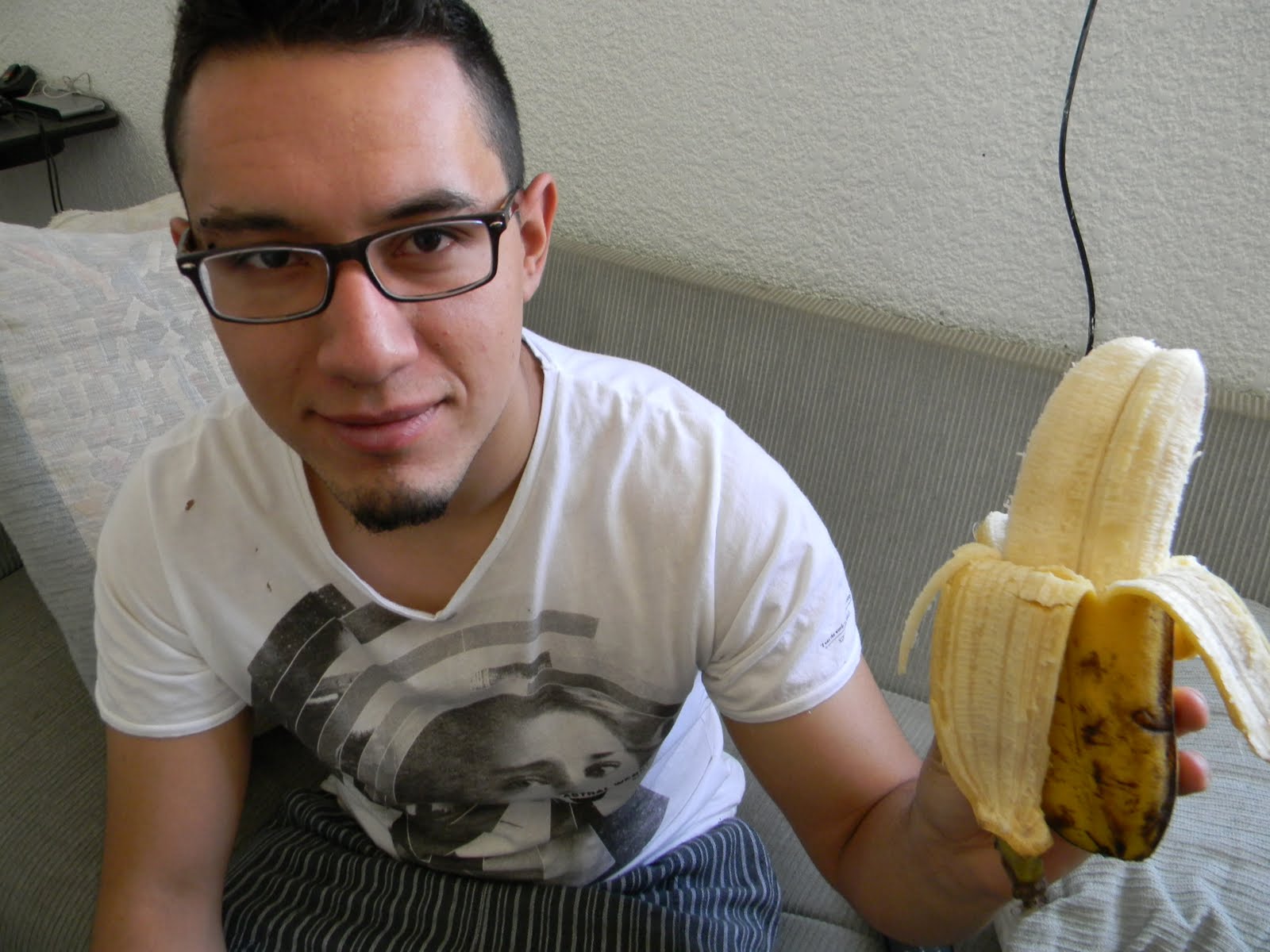
Things have been pretty mellow around here, just working my butt off and trying to have some fun in the in-between spaces. In the latter effort I have been taking pictures of the few friends I'm able to see these days. In the following pictures you'll see me with Pamela and Lupita in my kitchen (in two lovely portraits with microwaves and water heaters...in which you should also note that my hair has grown long enough to put in two awkward-tiny french-braids! Though I will be the first to admit my lack of braiding skills, resulting in very weird hair situations sometimes), Alfredo (who recently learned to wrap a turban, much to his delight and much to my amusement at his colour choices... and in this photo is featured with a living example of how Mexico City is the public-make-out capital of the Universe) and Marcos, with whom we discovered a freakish double-banana at the corner store, which required a proper digital portrait.

This is Hacienda Mixiuhca's first trip into the wide world: yesterday some hippie group put up a little one-day-only bartering market in my hood, so I dropped in after school (would have brought some plants and participated but I saw on the Internets that you had to be "registered" to participate-- lame!). Anyway I dropped in, as I said, saw the middle-aged guy that runs the cooperative coffee shop near Jamaica, and met some kids who live in this crazy 6-story co-op in a squathouse in a nice neighborhood, with about thirty people, called Chanti-Ollin, which is Nahuatl (language of the Aztecs and related linguistic groups) for something like "Living Movement". They have composting toilets, gardens, bike-powered technology and other bitchin' projects. Worth checking out if you're a domie (or post-domie, though I say that once a domie, you're always a domie, so there's no such thing as an ex-domie, with very few exceptions). Anyway, the point is that I'm finding some good sources of anti-civilization vibes, sweet urban resistance projects, etc...

And then I talked to some kids who live in the Honorable National House for Students, which is a co-op, and houses kids from other states who come to study in the Federal District and have limited financial resources and they have a big hydroponics project on their roof. I visited them today, so the photos you see here are from that particular place. It was built in 1911 for that same purpose, but it, like any co-op, has gone through some rough moments in its history. Regardless, it seems in good spirits today. It's located in the infamous neighborhood of Tepito, a region of beautiful and dilapidated colonial architecture, pirated (insert any noun here)s, and the most barrio of the barrios of Mexico City, supposedly. I've never been scared in Tepito, but I've never been scared anywhere in the city, to be totally truthful. Regardless, it's supposed to be very dangerous. I must emphasize, however, that Tepito is NOT a "ghetto." Ghetto implies an isolation, a desperation, that comes with having no economy. Tepito is a buzzing economic microcosm of illegal everything, but very successful, despite the endemic poverty and rampant violent crime, robberies and other such delights. Anyway, so you squeeze between some street stands selling backpacks and batteries and keychains and other sundries, and knock on the beautiful and seriously degraded old (and gargantuan) wooden door. One of the locks is missing so you can see right in through a sort of accidental peephole. Figures move around within, in the sunlit entryway. The doorframe is a marvelous carved stone affair with images of various disciplines, which you can see in their photostream, which is pretty cool. There's a small plaque at 3m above the ground, that declares the building, buried though it is in a mess of informal commerce, the historic institution that it is (actually, it has been declared a Historical Monument by the National Institute of Anthropology and History). A bespectacled boy with a ponytail answers the door. I explain I met some of his housemates at the Barter Market in Mixiuhca and that I wanted to see their hydroponics project. I indicated that I had brought some seedlings to make it worth their time. He told me he was already headed that way and invited us in. He took us up to the tippy-top terrace, a wiggly-floored brick affair with a view of countless concrete rooves and the plants that grow in their accumulated muck, water cisterns, and two or three old church bell towers. On the kneewall of the terrace were small paintings of mushrooms and things with wings. A collection of tomato seedlings sat around in pots of dirt on one side, and a plastic-enclosed hydroponic system hid behind them. It's constructed of a series of 4-inch PVC pipe with holes in the top. Elbows on one end of each pipe permit each to be filled with nutrient solution, and a connector on the other with a 1-inch elbow sticking out permits the water to drain when directed downward, into another 4-inch pipe, that drains the excess downward into some kind of catchment to be reused. It's really cool! They germinate their lettuces in petri dishes and let the seedling grow up in little tiny dixie cups in some kind of mix of coconut husk and vermiculite with what I suspect is humus mixed in there. Then they stick them in little round holes in the top of the 4-inch PVC. It's pretty genius. The kid said the hard part was coordinating people. Yeah, tell me about it (can I get a witness, domies?). But he was really nice for showing us around, and even though he didn't seem to want my plants (though another kid took me up on my offer of basil plants, I learned that eggplant and okra are not too popular). Anyway, so that was that. I hope to see more of those folks, because it seems like an interesting place.
I hope to be able to visit Chanti-Ollin next weekend, so you'll probably be seeing shots of that crowd next week.

Wednesday, May 19, 2010

Hacienda Mixiuhca in Photos, plus, Quejas y Sugerencias

It's raining hard tonight, and through the window I can see the lightning flash and hear the thunder growl. I spent most of the afternoon arming my third planter box and transplanting things into it. Frankly I have more plants than space, but ain't that the way. Maybe I can find somebody who wants some seedlings...


Whatever. The biggest news in my life is that my mom is awesome and generous and for this reason I got the most badass graduation present of all time: a Nikon L110 digital freakin' camera. That's right fools, be jealous. Okay, but more importantly it means that I can photographically document my existence.

Okay, let's start with the fuzzies. You can see in the first photo the three trememdous birds that seem to be taking over my life: their names are El Verde, El Morado and La Pata. They are roaming around on the living room floor as I allow them to do a couple nights a week, which of course is followed by an intensive floor cleaning. It's worth it though to see them run around so cute in the house. They chase each other; we throw them crumbs and scraps and then they fight over them. Then suddenly they panic and go scrambling across the floor like maniacs. And of course, they never. shut. up. Then I have a picture of the little buggers in their "corral" which is actually just another planter box with a bit of netting over it. I'm going to have to block the holes under the cage so that they can run around loose in the cage without escaping. But for now this is the best I can do. There are some queries and questions I have about their proper alimentation and rearing. I have read that they need "grit," sand or fine gravel to mash fresh food up in their gizzard but I don't know what kind is acceptable. As far as calcium sources, I'm not sure what to do, maybe I can get some spare oyster shells from the marisquerías in the Jamaica market and crush them in a stone molcajete (Mexican mortar and pestle) or something. I don't know how fine the oyster shell has to be, or anything like that. I suppose I'll have to keep researching...

As you can see, the cage is a total wreck right now. We have all of Marcos' house painting supplies up there, plus dirt (which I brought home by taxi in a rainy Sunday adventure with Marcos to the Jamaica market, which I promised will be featured in a near-future post, because it's famous for its flowers, so it's kind of amazing), plus crates, dirty duck newspaper, "watering cans" of various materials... a whole slew of god-knows-what that is making the neighbors complain. Just the other day Marcos and I were on the roof before work and this man comes up from apartment 8 to tell us he thinks we're going to ruin the waterproofing on the roof. I say we've got it under control because everything is going to be elevated on upturned bricks, but he keeps preaching, and Marcos gives me these looks from behind the guy's back of "tell him he can suck it!" but of course I keep diplomatic and run the "don't panic sir, I'm an engineer" line, and he eventually goes away. Regardless, gave me a scare. I worry about being hated for my antics, and have fever dreams about evictions and angry townspeople bearing torches.

Regardless, there is a bright future ahead (I mean, just look at that gorgeous view from the rooftop...). I nearly have the third box built and it's all going together soon. Photos soon.

In the meantime I'll go through the inventory of photosynthetic beings: we have approximately 15 baby little basil (albahaca) seedlings (--> pesto and bruschetta in my future...) and some little cilantros (slow-germinating little buggers!), a bunch of recently-germinated sunflowers (though I think they're going to be part of my guerrilla project down by the Metro entrance once they grow a bit, more on that later), an oregano and a lavender in the apartment, about 20 eggplants, six Armenian cukes in a paint can, a ton of marigold (cempazuchitl), some "rooster crest" (another flower, Celosia argentea var. cristata, according to a not at all intensive or academically acceptable investigation I just did in Google; photo gracias a http://www.flickr.com/photos/29280961@N03/2992976166/, whose flikr album includes the appropriate comment, "joder, que flor más rara!"), about thirty okras just barely pushing their fuzzy cotelydons skyward, four tomatoes, and a bunch of mustards and Asian greens. It's not a bad variety, really. I just soaked and planted some more cilantro, so I'm hoping for a continuous crop... I just gave a cuke to the fruit vendor in front of the Metro entrance, and he told me he'd bring me a guava sapling (WTF am I going to do with a sapling if I don't even have space for herbaceous plants? But, hey, I'm stoked that little practical detail notwithstanding). So I'm kind of thinking about trying to rig up some kind of hydroponic doodiddy, you know, like those hanging bags of strawberries and tomatoes-- holy goodness, I gotta get me some strawberries.

Then, of course, there's my muchachas, my worms, who may have to be moved to avoid the intense heat of a Mexico City roof in summer. I had bought them from a little garden shop run by Gringa expats in the swank Colonia Roma, at 50 pesos for 40ish worms. Anyway, so I passed them of to Alf and we set them up a little crate on his begardened roof and there they lived, and so he passed me some recently and I think they're taking off though they might have suffered a major blow from the heat... I'll have to check on their population tomorrow. Regardless, I definitely have plenty to feed them, so if they survive they'll put me a step closer to a decently improved level of sustainability, or so I hope.

Sunday, May 9, 2010

My belly is cheeping

Mi panza está piando.

There are three birds inside my t-shirt, a little yellow female duckling, and two chicks, green and purple, of unknown sex. They are hiding from the cold world as it rains outside, and as the gross color of city lights on smog replaces the stunning blue of the daytime sky (okay, it's only stunning if you look straight upward, because from any more oblique angle you can see the sewage-coloured film of smog between you and the stratosphere even on the clearest of days...).

I think the duck just pooped in my belly button. I guess it's a shower night.

Today's post is about livestock management. Clearly, integrated livestock management in the city involves two important details:

1. Reading the newspaper a couple times a week, and
2. Eating more greens.

And sharing your t-shirt with infant poultry, of course, but that's just a bonus. The newspaper element is all about substrate: it's the floor of their "corral" (aka wooden fruit crate I shamelessly dug out of the garbage-- more on the dumpster diving schtick later), plus I shred it up on top so that they have something semi-comfy to sleep on/search for food under, which is their favorite pastime, other than escaping and consequently freaking out. The part about greens is good for your health but also about creating lots of stems and funky gnar leaves for the chicks to eat (which is amusing to watch as they have not mastered the technique and spend a lot of time throwing around the tiny bits of green stuff). I feel like it's good practice for the steady diet of scraps they will soon be getting.

In economic terms, these animals are not at all expensive: initial investment of animals + a kilo of feed ran me fifty pesos, a bit over four bucks. I'm still using the same feed. Since the corral was dumpster dived, the infrastructure has cost me zilch (though during the day I put them in one of my planter boxes on the roof so they can have some "fresh" air and a bit more space... regardless of which I will not include the cost of building that planter box in the analysis), but the newspaper investment is not negligible: i pay ten pesos (slightly less than a dollar) per paper (for good quality reporting and quality and quantity of newsprint: the cheapest bullshit newspaper you can get runs at three pesos, but it's about a third to half the total paper of La Jornada, Mexico's best newspaper, the one that all the intellectuals read and it's kind of crappy quality paper, all color-printing too, so NOT absorbent), and I've got to buy one every three days or so. So we're talking about thirty pesos a week and I haven't figured out what to do with the used paper. Right now it's all rolled up in another, smaller fruit crate that both chicks are very capable of escaping from. Ideas would be appreciated; otherwise I'll have to throw it out. Maybe I can find something to mulch. Furthermore I don't know what to do for nesting substrate once they get older. I'm planning to build them a little laying hutch in one of the wooden things, using the wooden tray (1m x .5m, 5 cm deep) as the nest and then constructing some kind of angled roof out of wood and Congling the sucker with Tetrapak milk cartons. Thoughts on the matter would be appreciated.

Finally, the topic of the richness of the garbage. This is a middle-class neighborhood, so people throw a lot of shit out. At about ten AM on weekdays, you can hear the chubby ponytailed garbage guy holler, "BASURAAAAAAAAAA" in the parking lot, where he waits around with his little garbage cart. with big objects tied around it, from which blessed apparatus I have scored the following:

1. A coffee table
2. A strange and ugly piece of furniture of which I will eventually post a photo and which I use as a nightstand
3. Three fruit crates (a little one and two big ones)
4. a stool base with no seat
5. a giant waterbottle which is now a pot for salad plants.

The Universe provides. Marcos and I are scheming of ways to get into the dump (which is right across the street) to go on more advanced dives. Further updates as information becomes available.
.
Okay y'all, that's the latest on Hacienda Mixiuhca. Be safe, be courteous.

Wednesday, May 5, 2010

SB1070


Get your Gringo Mask! It's another political diatribe! Up and at 'em, folks, we're going to talk about racism!

I suppose this is as big of a news item back in Califas as it is here, the new Arizona law that allows regular police to do what the immigration police are supposed to do (deport visaless workers). Here, obviously, it is very unpopular. Based on the photos of the protest in LA, opposition over there is pretty damn gigantic.

Since remittances (money sent from across the border) are the second most important source of income on the national level (http://www.americaeconomica.com/portada/reportajes/enero07/120107/clmexicovi.htm, right behind petroleum and right ahead of foreign investments and tourism), I can see why people are upset, even outside the basic offense of declaring that by existing in a certain place at a certain time, suddenly people are criminals. I mean, economically, it's essential that Mexico send people north of the border: people here have referred to this mechanism as an "escape valve" that keeps the lower classes from starting a second revolution. This is why the Mexican government is falling all over itself to condemn the law.

The people I talk to day in day out, however, have more basic human reasons to denounce the law. It appears to give "probable cause" to any pig on the street to stop, search and demand papers of any brown person they may happen across (like the Gestapo in Nazi movies, "Papiere, papiere!!"), which is kind of giving the green light to racial profiling, and furthermore potentially humiliating to a lot of innocent people (though I'll stick my neck out and suggest that illegal immigrants are not in fact "guilty" of anything other than a totally gnarly commute).

My co-worker Alejandro started to lecture me about how crossing borders is a very important legal issue, and how the gringos have the right to exclude people, because, you know, how would you feel if some random came into your backyard... I didn't bother explaining how my backyard was basically a hangout for randoms, weirdos, homeless folks and can collectors, drunks, addicts, dirt hippies, children, and abandoned roosters. I went straight to the point: you're a big fat malinchista! (Let it be known that I didn't make this comment in mala onda and that he is neither big nor fat, though malinchista maybe a little...). But... I had to bring up that the palefaces are indeed tecnically illegal immigrants themselves, and of course to support my point I used this cartoon. It's valid to support your arguments with cartoons, right?

Anyway, so I read recently that Sonorenses (folks from Sonora, Mexico, the state just south of AZ) are boycotting (haciendo boicot) Arizona stores, which has actually made a significant impact on the borderland's economic landscape, according to the Mexican newspaper El Universal. A Mexican-American baseball player on the SD Padres has refused to play a game or tournament or something in Arizona... it's a pretty big deal.

So... defend human rights: snub Arizona.

Friday, April 23, 2010

Hacienda Mixiuhca: Cultivo y Cría Clandestina

Okay, so my 6 square meter farm is still kind of theoretical at the moment, but it's definitely in the works. So I live in one of those soviet-style groundscraper complexes, but what we've got aside from a really lovely looking and smelling magenta rose in the parking lot is a cage on the roof for drying clothes. This is the space I have to work with; it is my hacienda.

Hacienda Mixiuhca is rather unimpressive at the moment, with four tomato seedlings (Cherokee Purples! "imported" from la Gabacha (aka Gringolandia, aka El Otro Lado...etc), fancypants lettuces, Asian species of mustardy thing s (tatsoi, mizuna, bok choy, etc), ten or so eggplants, and marigolds. All of this growing in gutted, white-painted waterbottles lying on their sides. The infrastructure consists of 5 wooden trays (1m x .5m) that have been there since Marcos moved in 8 months ago. The plan is to build them up into containers; I'm thinking maybe 18 inches deep (though I'd only fill them to 15 inches-- that should be deep enough for tomatoes, right?). They're pole tomatoes, so I'm hoping to take advantage of the cage situation. The Armenian cukes I plan to swipe from Alfredo (whose roof garden will be the subject of a later post, once I have a digital camera, (which shall be a gradumation present extraordinaire!) can climb up strings I plan to tie to the top of the cage (because I'm going to have to put them on the walled-in side of the cage). The green stuff will have to go in the shadier part of the cage. But since the planters are pretty big, I think it should all go swimmingly. The issue here is cost, of course: the construction of these planters is going to run me from 140 to 280 pesos a piece. (A short one for lettuce, flowers and mustard)... That means about 90 bucks total. Then there's the issue of filling them with soil. At Home Depot (yes, capitalist bullshit palace, but the only nearby resource for such things) a gunnysack of soil runs about 13 bucks (145 pesos). In Tlanepantla, close to Alfredo's house (and about an hour and a half from here without traffic: bus to metro line 2 or 7, transferring to line 9) costs about 2 and a half bucks (30 pesos) piece. Slightly coarser texture, and farther away. I can only carry about one sack at a time, and it's tiring as hell, because they're really heavy. The bus costs about 10 pesos, the metro 3. So that brings the total per-sack cost of soil to 56 pesos, plus a lot of trouble. But considering that's less than half of the cost buying from HD (CBP), and I'll need about two sacks per planterbox, that will make a big difference. So let's see, say I build 4 boxes, one short, three tall: 920ish pesos plus (56 x 8) = 1,368, or about a hundred and ten ish bucks. That's a bit less than what I make per week. But at Hacienda Mixiuhca, we know that these things can be overcome.

Okay, in these harsh times, waste is unacceptable, especially on fabulous haciendas like mine. I have also swiped some worms from the worm crate we rigged up at Alf's place as well. They are currently writhing around in a yogurt tub in my bedroom with some seriously befungused papaya skin. I have a collection of frozen worm food in my fridge for when their population becomes ready for it. I'm trying to decide whether it's better to get a sealable plastic bin from the Home Depot nearby (a semi expensive and cop-outty option) or try to use the wooden crate I picked up off the street, which would have to live on the roof instead of in the kitchen for smellular reasons, is less easily sealed, more complicated, but cheaper and with more street cred. Any thoughts, opinions, designs and other inputs would be appreciated.

And what is an hacienda without livestock? I broke the news of my fowl conspirations to Marcos about a week ago when his Yucatecan buddy came to visit. We were sitting around drinking wine and suddenly I go: "Hey Marcos, what are your feelings about ducks?" And of course he gave me his drunken "what" face and I said, "You know, as animals. What do you think of them?" And of course his response is, "I don't know, I guess they're okay. Why?" So I had to tell him that I was going to buy a couple of ducklings, and asked if it would bother him if I kept them in the clothes cage. "Uh... sure. Why?" "Marcos," I told him in all seriousness, "The best pets are comestible pets." And he considered this for a moment, probably wondering what the nicest way to call me a sick bastard might be, before saying, "That sounds okay. Do you know how to cook duck?" And, okay, the answer is not really, but I mean, this is the age of the Internet. How hard could it be? Furthermore, I have a book of fowl-and-lagomorph rearing instructions from the British Ministry of Let's Not Starve written during the second world war, which is awesome because it's how to grow aminals on the most limited resources possible.

So the plan is to go the market La Merced on Sunday or Monday, pick up some little fuzzies and see what happens.

Viva La Hacienda Mixiuhca!

Friday, April 16, 2010

Hurbanistorias

Mi Rancho

Well. Here I am, center of the Universe, Mexico City, Mexico. Land of deaf-dumb subway singers, endless environmental disasters, lost lonely people from anywhere else, hundreds of years of history, swank hipster hangouts, yuppie rent-a-bike, one of the richest men in the world, starving drunks, singsong accents, and uncountable other oddities. It's the land of constant stimulus.

I live in a neighborhood called Jardín Balbuena, actually a very pleasant place to exist in the bourough ("delegación") Venustiano Carranza (see map), a block away from the metro station Mixiuhca, across the four-lane Eje 3 Sur from Jardín Balbuena, a big park where they put a big tianguis every Monday and Thursday, where you can find anything from forks to blankets and curtains, 15 peso pants, used digital cameras (and good ones!) to produce, tlacoyos and raw chicken (whole or in pieces!). I'm also within walking distance from the Olympic Velodrome they put up in '68. It's a funny neighborhood because though rent's relatively cheap, we're just a couple blocks from some really nice houses. Must be the screaming of landing airplanes...

My roommates are graphic designers. I actually only know one (the one with his name on the lease), because the other one's been in Guadalajara for the last few weeks apparently. I don't even know that one's name. Well anyway, the one I do know is called Marcos, a very San Francisco boy with rectangular glasses and a sort of reserved demeanour (till you get half a bottle of wine in him anyway). He keeps the place very clean and hangs out with me when I get back from work all grizzled and tired. Smiles a lot.

La Chamba


Oh yes, work. The thing that permits me to stay here... I found a job doing the most obvious thing possible: teaching Ingrish. I'm teaching at a private company in the neighborhood of Lomas de Chapultepec (=> Cha-pool-teh-PEC), which is kind of like Pacific Heights on a Dubai acid trip, all colonial and modern mansions with jararandas in bloom, shiny cars, and glass-and-steel high rises hovering around. Writhing masses of three-piece suits. But the place I'm working at is by and large okay; my co-workers are funny and interesting, the pay is all right, and I feel like I'm doing something useful.

The Metro is my friend. I clock into work just before 1pm every day except Saturday (when I start at 9am) and Sunday (which is obviously God's day of rest so I don't go to work), so I have to go running out of the house around 12:45. Fall down the stairs, two stories down to the door of my building, sprint across the parking lot/playground (go figure) open the front gate and hundred-yard-dash to the Metro stairs, past the fruit stand with the middle-aged guy who greets me every time ("buenas tardes güera!"), the torta stands, and down into the belly of the Metro, that swallows me up as I slip my ticket into the slim silent mouth of the turnstile, disappear into the gum-on-the-ceiling tunnel that leads me to the other platform, the Tacubaya direction platform, where an orange train will sweep me away to the next stage of my trip. Every morning an adventure, the same vendor selling Danzón CDs (I already bought one, but still I always want to dance when he busts out his Benny Moré and Pérez Prado...). Seven stations later I'm in Tacubaya, scuttling around the twists and turns, following the orange arrows to transfer to Line 7 toward El Rosario. Two stations later there I am in Auditorio, probably the deepest station in the damn Metro system, and I'm bounding up shit-tons of stairs, embarrassingly tired as I reach the top, panting like a dog in the summer, and crawl out into the world and onto my Palmas bus, which ten minutes later has me spilling out onto the sidewalk next to the Iglesia Covadonga and the taquero who greets me every day as he unloads his delicious fare from his truck. "No vas a comer tacos hoy, güera?" "No señor, hoy no puedo, voy con prisa, pero mañana seguro." Crossing Palmas is the last dangerous task of the afternoon (provided I have no kids classes scheduled for the day...) and then I wave through the glass door and Rogelio lets me in with the buzzer-button, usually greeting me with some sassy comment or other.

All images come from the Internets. The station symbols are from the Metro website: http://www.metro.df.gob.mx/ and the map is from Wikipedia (the brains of society...)

Thursday, February 11, 2010

More Adventures on the Peninsula and Under the Gulf


The world is clouding over again; 4 days of gorgeous sun and running around, but all things must pass, as a great English coleopteran once said.
Back to business...

Part 3 Cont'd: QUINTANA ROO

Moving along from Pet-cakab, we went to see a parcel of pitahaya, commonly known in Gringolandia as ''dragonfruit''. It's a cactus, but in vine format, and they grow it on giant posts. The parcel was owned by a little old lady, and the soil was red.

Part 4: YUCATÁN

A kid from Mérida once told me that the best hammocks are Yucatecan hammocks, and that was the first thought on my mind rolling into Pisté, Yucatan in the afternoon. After food. Because food is always first... so a few of us went out to find food. There are a couple of typical dishes we tried, one being cochinita pibil which is like pulled pork in a delicious sauce, and sopa de lima, which uses a fruit similar to the meyer lemon for flavor in a tomatoey brothy soup with meat and vegetables. After food came the hammock search. Well, I'll go ahead and tell you that there's not a whole lot in Pisté, just motels and tourist shops, and in one of them I found a beautiful cotton hammock and sat around chatting with the little old shopowner, who lowered the price a bit for me (or that was his claim), but it seemed reasonalble at about 25 bucks so I felt pretty good about the whole thing.

Later, the lot of us went to Chichen-Itza for the Espectáculo de Luz y Sonido, which I very much do not reccomend, because though it's cool to see pyramids at night, they don't let you wander around, they just sit you in one spot and talk at you with colorful lights.


The following day we went to see a henequen (sisal, as it's often called) hacienda called Hacienda Sotuta. We did the whole tour, which included a walk around the giant beautiful Spanish-tile laden, wooden-furnished house, and a ride on the little donkey-pulled carts they used in the old days to move the henequen around. Henequen is funny, it's an agave that they use for fiber, so after cutting off the oldest leaves, they bundle them, move them, unbundle them, smash them, brush out the fibre and dry it, then they make twine and rope and such things out of it. It's incredibly strong material.

This photo of a little old man I took outside the
hacienda, where he was selling his peeled oranges: I'm including it in the blog because he has this cool little springloaded orange lathe which is what he uses to peel them! Fun machines!

Part 5: TABASCO

Ah, Tabasco, land of mosquitos and chocolate. We arrived in Comalcalco in the late afternoon, at the house of a friend of the professors. We were to camp on his porch and in his backyard in his outskirtsy and pleasant town. This friend studied with them at the University in the '70s, but two years ago he got multiple sclerosis and now he's paralyzed from the neck down, in a wheelchair, barely able to speak. But he chatted with us students, and even gave us a little motivational speech on our last night at his house. It was pretty incredible.

We spent three days in the chocolate orchards, looking at problems with diseases, learning about exports, and of course, the process of making chocolate, which is one of the most amazing-smelling things I have smelt in my life.
The cacao tree gets to be about 5m tall maximum (COMMENT: THE CACAO PHOTOS ARE
NOT MINE, I STOLE THEM FROM THE VAST BELLY OF THE INTERNETS), though often it's pruned shorter. There are various varieties, but supposedly the most precious and cocoa-
butter-rich is the creole cacao. It's native to Mexico, and traditionally made into drinks, such as polvillo, a mix of ground cacao, cinnamon and toasted corn. It's delicious... Tabasco is the most important state in cacao production, but Oaxaca appears to be more important inasmuch as the production of chocolate (processed cacao). Let's see, it grows in giant pods, or 'cobs' on the
trunk of the tree, and these pods house about 20-ish seeds per, which are surrounded by a fleshy white pulp that tastes a bit like
a litchi. These seeds are dried in the sun, or fermented,
these processes producing different flavors. Normally the fermented grains are mixed with the dried grains to get a nice mix of smooth and 'robust' flavors. I ought
to mention that it's a shade plant, so they plant a variety of nurse trees, usually banana when the cacao are saplings, later establishing leguminous trees and mangoes, chico sapote (chicle, or gum tree) or other species to not only shade the cacao but also provide other sources of income.

Finally, I'm going to make mention of a tree worth mentioning, the noble ceiba, of which there are several examples in the UCD Botanical Conservatory (though they pale in comparison to the real deal in its rainforest wonderland...). This is a ceiba portrait I took in Palenque.


About Me

My photo
curiouser and curiouser

Blog-zombies!