First, the bad news. Then, the good news.
It's been a fungal massacre, with all this damn rain. I lost ALL of my basil plants.
There has also been a chicken massacre, and in this way I lost ALL of my salad greens.
Regardless, I still have a bunch of okra, all my tomatos, two of my cukes, and some marigolds (though I did have to sacrifice some of them for reasons of exaggerated competition). I'm trying out this upside-down hanging planter idea that NPR told my mom about. Furthermore I have abandoned the idea of organic ag in the city. It's not space efficient. Ergo, slow-release granular fert from Mercado de Jamaica. Tomorrow: photos.
Now, Hurbanaventuras:
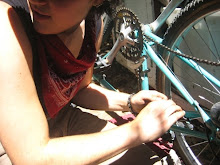
I helped one friend give a basic bike-repair workshop downtown today, near the Monument to the Revolution, and brought Marcos' grandpappy's bike to fix that sucker up a bit. The plan was then to quickly drop it off at home, then go meet my other friend in the Coyoacan metro station. However, the plan was somewhat derailed when we took too long on the bike, so I had to go straight to Coyoacan, bike and all. Which practically isn't a problem, since on Sundays they let you take your bike on the Metro. Regardless, the problems came after I decided the metro was lame and rolled the whole way there on two wheels (which felt SO GOOD after three and a half months of total bikelessness!!). The guy just didn't show. I however took the opportunity to chitchat with an old man selling tiny pueblan pies and then the Metro police (who are less trigger-happy, fortunately, than BART police...) and suddenly this guy with a funny accent shows up and asks where the center of coyoacan is. I tell him I can help him get there, since I am at this point TOTALLY done with waiting for my no-show buddy. So I give him the mini walking tour of the joint, and he invites me to eat, to which proposal I wholeheartedly agree. He then picks this hella trendy spot right on the Coyoacán plaza, all typical Mexican colors and dishes, all girls with scarves and hip boots and guys with intellectual glasses and stylized hairdos, and we order some of the best chilanga tlayudas I have ever eaten, a glass of pulque (which he found disgusting, though I like it), and a couple caballitos of strong-as-hell mezcal. It turned out he's a Colombian lawyer, and he was leaving for his home turf this very night. The point is, it was this sort of Universe-speaking-to-me kind of moment and it was kind of fun to share some of the Mexico I've discovered with a lost foreigner. It was this weird consolidation exercise... okay. to bed. tomorrow i'll post hacienda pictures... buenas noxes.
Showing posts with label Andando en dos ruedas. Show all posts
Showing posts with label Andando en dos ruedas. Show all posts
Sunday, July 4, 2010

Sunday, May 30, 2010
Merkado de Trueke and the Friendly Hippies I Found There
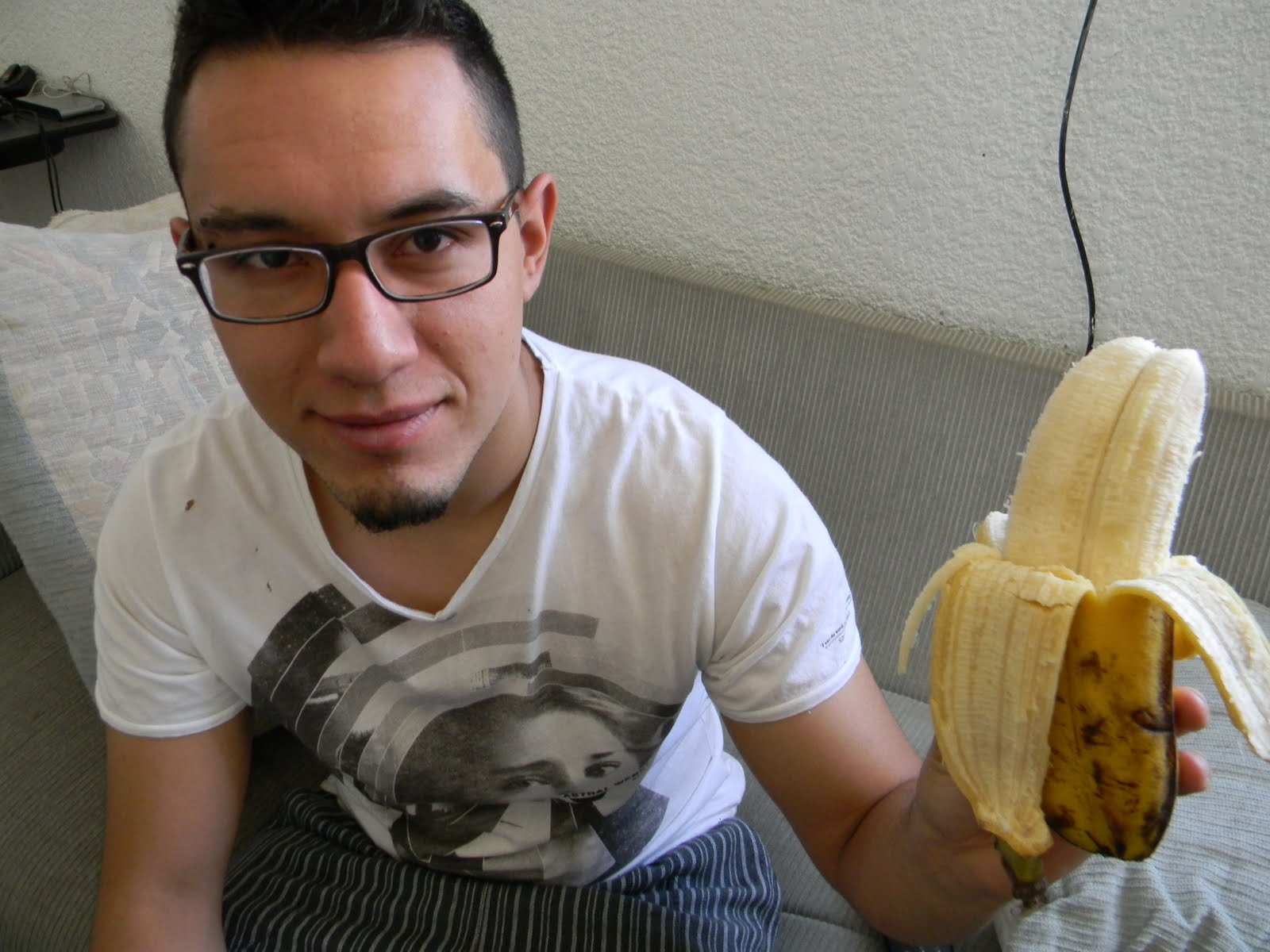
Things have been pretty mellow around here, just working my butt off and trying to have some fun in the in-between spaces. In the latter effort I have been taking  pictures of the few friends I'm able to see these days. In the following pictures you'll see me with Pamela and Lupita in my kitchen (in two lovely portraits with microwaves and water heaters...in which you should also note that my hair has grown long enough to put in two awkward-tiny french-braids! Though I will be the first to admit my lack of braiding skills, resulting in very weird hair situations sometimes), Alfredo (who recently learned to wrap a turban, much to his delight and much to my amusement at his colour choices... and in this photo is featured with a living example of how Mexico City is the public-make-out capital of the Universe) and Marcos, with whom we discovered a freakish double-banana
 at the corner store, which required a proper digital portrait.
This is Hacienda Mixiuhca's first trip into the wide world: yesterday some hippie group put up a little one-day-only bartering market in my hood, so I dropped in after school (would have brought some plants and participated but I saw on the Internets that you had to be "registered" to participate-- lame!). Anyway I dropped in, as I said, saw the middle-aged guy that runs the cooperative coffee shop near Jamaica, and met some kids who live in this crazy 6-story co-op in a squathouse in a nice neighborhood, with about thirty people, called Chanti-Ollin, which is Nahuatl (language of the Aztecs and r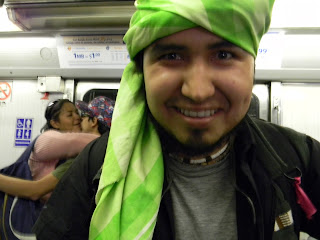 elated linguistic groups) for something like "Living Movement". They have composting toilets, gardens, bike-powered technology and other bitchin' projects. Worth checking out if you're a domie (or post-domie, though I say that once a domie, you're always a domie, so there's no such thing as an ex-domie, with very few exceptions). Anyway, the point is that I'm finding some good sources of anti-civilization vibes, sweet urban resistance projects, etc...
And then I talked to some kids who live in the Honorable National House for Students, which is a co-op, and houses kids from other states who come to study in the Federal District and have limited financial resources and they have a big hydroponics project on their roof. I visited them today, so the photos you see here are from that particular place. It was built in 1911 for that same purpose, but it, like any co-op, has gone through some rough moments in its history. Regardless, it seems in good spirits today. It's located in the infamous neighborhood of Tepito, a region of beautiful and dilapidated colonial architecture, pirated (insert any noun here)s, and the most barrio of the barrios of Mexico City, supposedly. I've never been scared in Tepito, but I've never been scared anywhere in the city, to be totally truthful. Regardless, it's supposed to be very dangerous. I must emphasize, however, that Tepito is NOT a "ghetto." Ghetto implies an isolation, a desperation, that comes with having no economy. Tepito is a buzzing economic microcosm of illegal everythin
 g, but very successful, despite the endemic poverty and rampant violent crime, robberies and other such delights. Anyway, so you squeeze between some street stands selling backpacks and batteries and keychains and other sundries, and knock on the beautiful and seriously degraded old (and gargantuan) wooden door. One of the locks is missing so you can see right in through a sort of accidental peephole. Figures move around within, in the sunlit entryway. The doorframe is a marvelous carved stone affair with images of various disciplines, which you can see in their photostream, which is pretty cool. There's a small plaque at 3m above the
  ground, that declares the building, buried though it is in a mess of informal commerce, the historic institution that it is (actually, it has been declared a Historical Monument by the National Institute of Anthropology and History). A bespectacled boy with a ponytail answers the door. I explain I met some of his housemates at the Barter Market in Mixiuhca and that I wanted to see their hydroponics project. I indicated that I had brought some seedlings to make it worth their time. He told me he was already headed that way and invited us in. He took us up to the tippy-top terrace, a wiggly-floored brick
 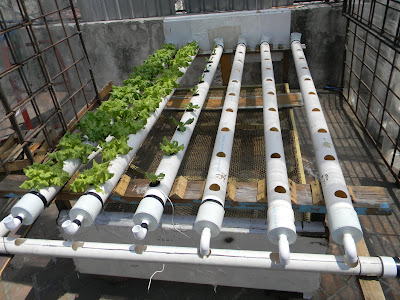 affair with a view of countless concrete rooves and the plants that grow in their accumulated muck, water cisterns, and two or three old church bell towers. On the kneewall of the terrace were small paintings of mushrooms and things with wings. A collection of tomato seedlings sat around in pots of dirt on one side, and a plastic-enclosed hydroponic system hid behind them. It's constructed of a series of 4-inch PVC pipe with holes in the top. Elbows on one end of each pipe permit each to be filled with nutrient solution, and a connector on the other with a 1-inch elbow sticking out permits the water to drain when directed downward, into another 4-inch pipe, that drains the excess downward into some kind of catchment to be reused. It's really cool! They germinate their lettuces in petri dishes and let the seedling grow up in little tiny dixie cups in some kind of mix of coconut hus
 k and vermiculite with what I suspect is humus mixed in there. Then they stick them in little round holes in the top of the 4-inch PVC. It's pretty genius. The kid said the hard part was coordinating people. Yeah, tell me about it (can I get a witness, domies?). But he was really nice for showing us around, and even though he didn't seem to want my plants (though another kid took me up on my offer of basil plants, I learned that eggplant and okra are not too popular). Anyway, so that was that. I hope to see more of those folks, because it seems like an interesting place.
I hope to be able to visit Chanti-Ollin next weekend, so you'll probably be seeing shots of that crowd next week.
 pictures of the few friends I'm able to see these days. In the following pictures you'll see me with Pamela and Lupita in my kitchen (in two lovely portraits with microwaves and water heaters...in which you should also note that my hair has grown long enough to put in two awkward-tiny french-braids! Though I will be the first to admit my lack of braiding skills, resulting in very weird hair situations sometimes), Alfredo (who recently learned to wrap a turban, much to his delight and much to my amusement at his colour choices... and in this photo is featured with a living example of how Mexico City is the public-make-out capital of the Universe) and Marcos, with whom we discovered a freakish double-banana
 at the corner store, which required a proper digital portrait.
This is Hacienda Mixiuhca's first trip into the wide world: yesterday some hippie group put up a little one-day-only bartering market in my hood, so I dropped in after school (would have brought some plants and participated but I saw on the Internets that you had to be "registered" to participate-- lame!). Anyway I dropped in, as I said, saw the middle-aged guy that runs the cooperative coffee shop near Jamaica, and met some kids who live in this crazy 6-story co-op in a squathouse in a nice neighborhood, with about thirty people, called Chanti-Ollin, which is Nahuatl (language of the Aztecs and r
 elated linguistic groups) for something like "Living Movement". They have composting toilets, gardens, bike-powered technology and other bitchin' projects. Worth checking out if you're a domie (or post-domie, though I say that once a domie, you're always a domie, so there's no such thing as an ex-domie, with very few exceptions). Anyway, the point is that I'm finding some good sources of anti-civilization vibes, sweet urban resistance projects, etc...
And then I talked to some kids who live in the Honorable National House for Students, which is a co-op, and houses kids from other states who come to study in the Federal District and have limited financial resources and they have a big
 hydroponics project on their roof. I visited them today, so the photos you see here are from that particular place. It was built in 1911 for that same purpose, but it, like any co-op, has gone through some rough moments in its history. Regardless, it seems in good spirits today. It's located in the infamous neighborhood of Tepito, a region of beautiful and dilapidated colonial architecture, pirated (insert any noun here)s, and the most barrio of the barrios of Mexico City, supposedly. I've never been scared in Tepito, but I've never been scared anywhere in the city, to be totally truthful. Regardless, it's supposed to be very dangerous. I must emphasize, however, that Tepito is NOT a "ghetto." Ghetto implies an isolation, a desperation, that comes with having no economy. Tepito is a buzzing economic microcosm of illegal everythin
 g, but very successful, despite the endemic poverty and rampant violent crime, robberies and other such delights. Anyway, so you squeeze between some street stands selling backpacks and batteries and keychains and other sundries, and knock on the beautiful and seriously degraded old (and gargantuan) wooden door. One of the locks is missing so you can see right in through a sort of accidental peephole. Figures move around within, in the sunlit entryway. The doorframe is a marvelous carved stone affair with images of various disciplines, which you can see in their photostream, which is pretty cool. There's a small plaque at 3m above the
  ground, that declares the building, buried though it is in a mess of informal commerce, the historic institution that it is (actually, it has been declared a Historical Monument by the National Institute of Anthropology and History). A bespectacled boy with a ponytail answers the door. I explain I met some of his housemates at the Barter Market in Mixiuhca and that I wanted to see their hydroponics project. I indicated that I had brought some seedlings to make it worth their time. He told me he was already headed that way and invited us in. He took us up to the tippy-top terrace, a wiggly-floored brick
  affair with a view of countless concrete rooves and the plants that grow in their accumulated muck, water cisterns, and two or three old church bell towers. On the kneewall of the terrace were small paintings of mushrooms and things with wings. A collection of tomato seedlings sat around in pots of dirt on one side, and a plastic-enclosed hydroponic system hid behind them. It's constructed of a series of 4-inch PVC pipe with holes in the top. Elbows on one end of each pipe permit each to be filled with nutrient solution, and a connector on the other with a 1-inch elbow sticking out permits the water to drain when directed downward, into another 4-inch pipe, that drains the excess downward into some kind of catchment to be reused. It's really cool! They germinate their lettuces in petri dishes and let the seedling grow up in little tiny dixie cups in some kind of mix of coconut hus
 k and vermiculite with what I suspect is humus mixed in there. Then they stick them in little round holes in the top of the 4-inch PVC. It's pretty genius. The kid said the hard part was coordinating people. Yeah, tell me about it (can I get a witness, domies?). But he was really nice for showing us around, and even though he didn't seem to want my plants (though another kid took me up on my offer of basil plants, I learned that eggplant and okra are not too popular). Anyway, so that was that. I hope to see more of those folks, because it seems like an interesting place.
I hope to be able to visit Chanti-Ollin next weekend, so you'll probably be seeing shots of that crowd next week.
Sunday, July 26, 2009
The Old Runaround
Silly picture of me, compliments of my classmate Mateo: 
1. Teotihuacan: A PreClassical Mexican Ghost Town, or, What´s In Store For Us
7. Museo del Estanquillo
2. De Don De Son, or, La Copia Pirata de Lo Autentico, PLUS discussion of *authenticity* as a topic
3. Ciclotón!, or, Lost in The Damn City
4 Gajillion. An Ode to Street Tacos
1. Two Sundays Ago! We went to Teotihuacan, all of us Californians, crawling around the once-time cultural hub of North America*. This was the place to be, man. If you weren't here, you were decidedly square. Here, my friends, is the story: we aren't totally sure where they came from, but they showed up on the north side of the lake system, set up shop, and eventually started building pyramids for the gods, as if to say: thanks for the hills, guys, that was really nice of you. We like them. We will make you some hills in return. No, I mean it. That was the idea. It was a reciprocity with the gods. Kind of like taking your friends out to coffee: you just do sometimes. But what wound up happening, and how the pyramids got so big was that every generation of rulers would be like, man, this pyramid just isn't big enough. (Can I mention that I figured out how to make apostrophes again? I'm stoked about apostrophes.) So they would build another pyramid on the outside of an existing pyramid. Because they were shrewd. And so their empire became the Mexico City of ancient Mexico, but they kind of outgrew their britches, overhunted, deforested, hogged all the commerce, and by 750 BC those suckers went DOWN. So when the Mexica (the proper name for the Aztecs: they were called the Mexica [pron. meh-SHEE-kah] but they always said they were from someplace called Aztlán [nobody is really sure where that is, but they think it's in the North someplace) arrived, all they found were vaguely pyramid-shaped piles of rocks: an eerie, oversized ghost town. And this city had it all: beautifully stuccoed, polished and painted buildings, a sewage system, city planning with a religious basis, bla bla bla. I'm pretty sure it gave the Mexica the heebie jeebies, but it was all for the best I guess because they went on to find their Eagle/nopal/snake experience and live happily for a while after. That was in the 1300s, so by then the joint was pretty broken down. BUT here's the deal: eventually a bunch
 of archaeologists found Teotihuacan, and like archaeologists, decided to break rocks and dig holes and generally poke history, and discovered that under these vaguely pyramid-shaped piles of rocks, there were... distinctly pyramid shaped piles of rocks, stucco, polish and paint intact because they had been protected all these years by the bigger-better pyramids that took all the flak from nature since the 700s. So, when you go to Teotihuacan, you go inside the pyramids (which in their heyday were not go-insideable, thank you archaologists). Basically they were totally badass engineers, but bad long-term planners.
Kind of like us.
 Whatever, afterward we went to go eat fancy dinner in a CAVE!! I ate the most delicious chicken mole in the world while marveling at the beautiful irony of a fancy cave.
2. For a school project, I went to the Museo del Estanquillo downtown with two other UC kids. The exhibit was called "Te Pareces Tanto a Mí", or, "You Look So Much Like Me". It dealt with portraits throughout Mexican History. I was looking at the Benito Juarez section, and there were these two English kids with very posh accents: "I suppose this fellow was quite important." No shit, homes. So I history-nerded them. "Um, yeah, he was kind of a big deal. First elected president of Mexico. Helped oust a dictator. Wrote the constitution, Booted the Catholic Church, was indigenous+in power which prior to that was unheard of. Got replaced with an Austrian monarch. Poor guy had no idea what was going on--his name was Maximilian, and really he was nice enough, he had just been duped by a gang of rich conservatives who for god knows what reason really wanted a king so they wrote his father a nice letter and said, O King Guy, send somebody to be our Absolute Monarch, that we may too be subjected to the unfettered power of someone so wealthy and ignorant as thee! So they shipped Max over and he lived in the Castillo de Chapultepec, and did some actually okay things, but then the Liberals showed up and Benito Juarez said, okay, look, I'm really sorry, but we're going to have to execute you now. That's just how it works when you stage a coup. Gotta set an example, you know. So that's how Max got offed. Anyway, Juarez then proceeded to be president for a very short while before he suddenly died, which on some level, was probably okay, because he died before he could start to look like a jerk, which is what any politician will eventually do, and this is a country that needed a national hero worse than any other concept. So that's Benito Juarez." And they looked at me, eyes as wide as dinner plates, and said, gee, thanks...

But the point of this story is more about the exhibit itself. It brings to light questions about the manufacture and distribution of IMAGES. Okay, here we are in a blog, the land of image-mongering, wherein we create and destroy ourselves and others at will. But think of it, mass publishing of images is a relatively new thing. How do you communicate to somebody in California that they have this guy in Washington DC telling them how to behave? I mean, it's mind boggling! And humans used to live in an image-bottleneck: few images, and few avenues for their distribution. It's a miracle that people even believed that government existed. No wonder there were a bunch of militias and other such wackos back then. So I'm not going to dawdle on this much longer, but I'm going to render for your digestion the discussion questions I generated for the presentation I co-led today on this exhibit:
1. Images and power: Who controls the creation and distribution of images? How do these images have power over us? What qualities of an image determine the answers to these questions (medium, distribution channel, creator, subject....)?
2. How do people in power use their own image? How is this image manipulated and used by others? What effect does this have on their power?
3. How do artists portray themselves and other artists? Why do we even care?
4. "Los demás": how can images serve to demarginalize or further marginalize people who have no power? What does this mean for our perception of them? What power have we to change this--how do images help give us this power?
NEXT!
DE DON DE SON
I may have mentioned to some of you the seemingly sketchball friendship I struck up in the metro: leaving Jafet's place for my new abode I was fraught about by my suitcase, backpack and uke: a piece I like to call one overloaded chick descending staircase, Metro Zócalo... when... a kid stops me and says, hey, what's that instrument? I show it to him, and he breaks out his jarana, and we talk about the tuning and where they're from... we exchange phone numbers and agree to jam. Only later did it occur to me that I am in no way ready for jamming of any sort. Jeez. We wound up meeting up for coffee one afternoon, and he taught me a little jarana technique, and then last Friday, we met at the Metro, this time I brought the Uke Machine, and walked to his friend's place, and I basically got to sit in on his band practice, which was AMAZING! His band is called De Don De Son (a play on words I will explain momentarily) and the music they play is called Son Jarocho. The story is that he and one of the other guys knew each other sort of kind of in their early days because they were both in punk bands around town. Then, simultaneously and without any communication on the topic, they both got into Son Jarocho, and that´s how they started playing together. Okay, one foot in front of the other. What is Son Jarocho? It´s a traditional kind of music from the state of Veracuz, right on the east coast of the Gulf of Mexico, and so it has sustained plenty of Spanish influence, as well as Carribbean influence. In its percussion and rhythm it reminds me a lot of Cuban music. The vocals, too, actually. Maybe you can find an example on the Internets, such as http://www.youtube.com/watch?v=C1VkMDWEjpU&feature=PlayList&p=CFDB9705486EDECC&playnext=1&playnext_from=PL&index=1 . Furthermore, the instruments are really beautiful. The jarana comes in several sizes, two of which were present here: the mosquito (slightly littler than a uke) and one slightly smaller than a guitar. They are organized in theory the same way as a uke: GCEA, but here's where it gets funny: each string is paired: so C, E and A come in duplicate to get a more sproingy sound, and so does the G but the G pair is split, top and bottom, I guess so you can't miss the string to ensure complete chords even when playing drunken-sloppily. Another string instrument is called the requinto, which looks in this case like a 5-string guitar whose strings you whack with a piece of bull horn which is shaped not like a pick, but a small paddle. Clearly it´s a very string-heavy ensemble, and everyone seems to play more or less every instrument (except for the tambourine guy, who seems to just play the tambourine-- but that´s not to knock tambourine guy, because I have never heard such tambourine-complexity in my entire life!). They were all really serious about the music, but they were clearly having the time of their lives. The songs are so beautiful; the verses get sung in turns, and the lyrics usually deal with very quotidian things, like food, love gone wrong, the countryside. So basically I went to a free concert. Ah, the name. They were playing once in a bar or in the metro or some such and they finished a song and somebody asked them, --De donde son?-- or, where are you from, so caught up in the contradiction that they sounded straight out of the boondocks of Veracruz but looked like Chilangos (Mexico City kids: t-shirts, skate shoes, cargo pants, weird hairdos...). Their band name is De Don (don means you´ve got a mastery of something) de Son (Son Jarocho). Last night they were joking about how they are an authentic pirated copy of Son Jarocho.
Which brings me to the question of authenticity: when you travel abroad, you find yourself seeking the holy grail of AUTHENTICITY. "Was it made by hand? Make it spicier, I can handle it! Is she indigenous or does she just dress like that?" People get these crazy blinders on. I guess there's a paranoia about getting duped, caught in a tourist trap, looking like a dumb foreigner. Well, guess what, I'm a dumb foreigner, and I think I've got to own up to it. I look around and I try to not normalize, necessarily, but think actively about how people behave, what they do to their appearances, what they eat, what they do all day, what their world looks like, smells like... I'm not here to buy The Real Mexico. You know what? I bet you fifteen pesos that there is no The Real Mexico, and that authentic is as relative as Who I Am. Cultural identity is fluid, and any attempt to put it in a box is going leave you cold.
NEXT!
Ciclotón! Sunday morning I woke up earrrrly so I could jump out of bed, onto my bike and go help Erika and Daniel fix bikes at the Ciclotón, which they've done a few times now and it's probably helping out their business to get this exposure to recreational cyclists. I figured out where to go on the map and got rolling. Down calle Mexico-Coyoacan (stopping at a spot called El Jarocho for coffee, which I brought with me in my sweet cylindrical belt-clipping thermos, thank you Margareta and Jaylee!!) to Avenida Rio Churubusco, where the roads were supposedly closed for cyclists. Gee, that's weird. A ton of cars, and no cyclists... Pass the Leon Trotsky museum... realize that Rio Churubusco is actually a big giant highway and that this is the Rio Churubusco Periferico... aha! Clumsily dash across street, climb over short fence with bicycle, y ya! But, of course, I went the wrong way, and called Erika from Patriotismo, to say, well... um... I'm on the opposite side of city? So with her instructions in mind, I bought a mole tamale, sucked down a little coffee, and took off, straying from the Ciclotón track, and rolling down Eje 4 alllllllltheway across the city. I got back to the track, made a wrong turn and in so doing had to fight the flow of traffic 5 kilometers, backtracked, and found the Planeta Cleta tent. They fed me, and I helped them out pumping tires and calibrating derailers for about an hour before I had to split. Boy was I tired. 4 hours lost on a bike in DF? Yikes. Here are some funny things I saw:
1. FIXIE KIDS!!! Just 2 of 'em. I don't know whether they were gabachos out for a jaunt or what, but they looked like somebody had transplanted them from Davis (more like Davis fixie kids than SF fixters).
2. Puppies in baskets.
3. A beaver-cleaver heterosexual nuclear family, Ma/Pa/2 kids/1 baby in trailer: all wearing the same orange and white striped polo shirts. It was the funniest thing. I laughed.
Not related, but cool: in Veracruz they do this religious dance in honor of the Precession of the Equinoxes (I pulled that term from a children's story), or the spinningness of the world, and they start of on top of a giant snag, where they are all sitting on a lazy susan, and one winds it up and then the other four go careening off as they spin around the tree. It's amazing...
Lastly, An Ode to Street Tacos:
Born of a giant basket on an old man's bike
How you are tasty.

1. Teotihuacan: A PreClassical Mexican Ghost Town, or, What´s In Store For Us
7. Museo del Estanquillo
2. De Don De Son, or, La Copia Pirata de Lo Autentico, PLUS discussion of *authenticity* as a topic
3. Ciclotón!, or, Lost in The Damn City
4 Gajillion. An Ode to Street Tacos
1. Two Sundays Ago! We went to Teotihuacan, all of us Californians, crawling around the once-time cultural hub of North America*. This was the place to be, man. If you weren't here, you were decidedly square. Here, my friends, is the story: we aren't totally sure where they came from, but they showed up on the north side of the lake system, set up shop, and eventually started building pyramids for the gods, as if to say: thanks for the hills, guys, that was really nice of you. We like them. We will make you some hills in return. No, I mean it. That was the idea. It was a reciprocity with the gods. Kind of like
 taking your friends out to coffee: you just do sometimes. But what wound up happening, and how the pyramids got so big was that every generation of rulers would be like, man, this pyramid just isn't big enough. (Can I mention that I figured out how to make apostrophes again? I'm stoked about apostrophes.) So they would build another pyramid on the outside of an existing pyramid. Because they were shrewd. And so their empire became the Mexico City of ancient Mexico, but they kind of outgrew their britches, overhunted, deforested, hogged all the commerce, and by 750 BC those suckers went DOWN. So when the Mexica (the proper name for the Aztecs: they were called the Mexica [pron. meh-SHEE-kah] but they always said they were from someplace called Aztlán [nobody is really sure where that is, but they think it's in the North someplace) arrived, all they found were vaguely pyramid-shaped piles of rocks: an eerie, oversized ghost town. And this city had it all: beautifully stuccoed, polished and painted buildings, a sewage system, city planning with a religious basis, bla bla bla. I'm pretty sure it gave the Mexica the heebie jeebies, but it was all for the best I guess because they went on to find their Eagle/nopal/snake experience and live happily for a while after. That was in the 1300s, so by then the joint was pretty broken down. BUT here's the deal: eventually a bunch
 of archaeologists found Teotihuacan, and like archaeologists, decided to break rocks and dig holes and generally poke history, and discovered that under these vaguely pyramid-shaped piles of rocks, there were... distinctly pyramid shaped piles of rocks, stucco, polish and paint intact because they had been protected all these years by the bigger-better pyramids that took all the flak from nature since the 700s. So, when you go to Teotihuacan, you go inside the pyramids (which in their heyday were not go-insideable, thank you archaologists). Basically they were totally badass engineers, but bad long-term planners.
Kind of like us.
 Whatever, afterward we went to go eat fancy dinner in a CAVE!! I ate the most delicious chicken mole in the world while marveling at the beautiful irony of a fancy cave.
2. For a school project, I went to the Museo del Estanquillo downtown with two other UC kids. The exhibit was called "Te Pareces Tanto a Mí", or, "You Look So Much Like Me". It dealt with portraits throughout Mexican History. I was looking at the Benito Juarez section, and there were these two English kids with very posh accents: "I suppose this fellow was quite important." No shit, homes. So I history-nerded them. "Um, yeah, he was kind of a big deal. First elected president of Mexico. Helped oust a dictator. Wrote the constitution, Booted the Catholic Church, was indigenous+in power which prior to that was unheard of. Got replaced with an Austrian monarch. Poor guy had no idea what was going on--his name was Maximilian, and really he was nice enough, he had just been duped by a gang of rich conservatives who for god knows what reason really wanted a king so they wrote his father a nice letter and said, O King Guy, send somebody to be our Absolute Monarch, that we may too be subjected to the unfettered power of someone so wealthy and ignorant as thee! So they shipped Max over and he lived in the Castillo de Chapultepec, and did some actually okay things, but then the Liberals showed up and Benito Juarez said, okay, look, I'm really sorry, but we're going to have to execute you now. That's just how it works when you stage a coup. Gotta set an example, you know. So that's how Max got offed. Anyway, Juarez then proceeded to be president for a very short while before he suddenly died, which on some level, was probably okay, because he died before he could start to look like a jerk, which is what any politician will eventually do, and this is a country that needed a national hero worse than any other concept. So that's Benito Juarez." And they looked at me, eyes as wide as dinner plates, and said, gee, thanks...

But the point of this story is more about the exhibit itself. It brings to light questions about the manufacture and distribution of IMAGES. Okay, here we are in a blog, the land of image-mongering, wherein we create and destroy ourselves and others at will. But think of it, mass publishing of images is a relatively new thing. How do you communicate to somebody in California that they have this guy in Washington DC telling them how to behave? I mean, it's mind boggling! And humans used to live in an image-bottleneck: few images, and few avenues for their distribution. It's a miracle that people even believed that government existed. No wonder there were a bunch of militias and other such wackos back then. So I'm not going to dawdle on this much longer, but I'm going to render for your digestion the discussion questions I generated for the presentation I co-led today on this exhibit:
1. Images and power: Who controls the creation and distribution of images? How do these images have power over us? What qualities of an image determine the answers to these questions (medium, distribution channel, creator, subject....)?
2. How do people in power use their own image? How is this image manipulated and used by others? What effect does this have on their power?
3. How do artists portray themselves and other artists? Why do we even care?

4. "Los demás": how can images serve to demarginalize or further marginalize people who have no power? What does this mean for our perception of them? What power have we to change this--how do images help give us this power?
NEXT!
DE DON DE SON
I may have mentioned to some of you the seemingly sketchball friendship I struck up in the metro: leaving Jafet's place for my new abode I was fraught about by my suitcase, backpack and uke: a piece I like to call one overloaded chick descending staircase, Metro Zócalo... when... a kid stops me and says, hey, what's that instrument? I show it to him, and he breaks out his jarana, and we talk about the tuning and where they're from... we exchange phone numbers and agree to jam. Only later did it occur to me that I am in no way ready for jamming of any sort. Jeez. We wound up meeting up for coffee one afternoon, and he taught me a little jarana technique, and then last Friday, we met at the Metro, this time I brought the Uke Machine, and walked to his friend's place, and I basically got to sit in on his band practice, which was AMAZING! His band is called De Don De Son (a play on words I will explain momentarily) and the music they play is called Son Jarocho. The story is that he and one of the other guys knew each other sort of kind of
 in their early days because they were both in punk bands around town. Then, simultaneously and without any communication on the topic, they both got into Son Jarocho, and that´s how they started playing together. Okay, one foot in front of the other. What is Son Jarocho? It´s a traditional kind of music from the state of Veracuz, right on the east coast of the Gulf of Mexico, and so it has sustained plenty of Spanish influence, as well as Carribbean influence. In its percussion and rhythm it reminds me a lot of Cuban music. The vocals, too, actually. Maybe you can find an example on the Internets, such as http://www.youtube.com/watch?v=C1VkMDWEjpU&feature=PlayList&p=CFDB9705486EDECC&playnext=1&playnext_from=PL&index=1 . Furthermore, the instruments are really beautiful. The jarana comes in several sizes, two of which were present here: the mosquito (slightly littler than a uke) and one slightly smaller than a guitar. They are organized in theory the same way as a uke: GCEA, but here's where it gets funny: each string is paired: so C, E and A come in duplicate to get a more sproingy sound, and so does the G but the G pair is split, top and bottom, I guess so you can't miss the string to ensure complete chords even when playing drunken-sloppily. Another string instrument is called the requinto, which looks in this case like a 5-string guitar whose strings you whack with a piece of bull horn which is shaped not like a pick, but a small paddle. Clearly it´s a very string-heavy ensemble, and everyone seems to play more or less every instrument (except for the tambourine guy, who seems to just play the tambourine-- but that´s not to knock tambourine guy, because I have never heard such tambourine-complexity in my entire life!). They were all really serious about the music, but they were clearly having the time of their lives. The songs are so beautiful; the verses get sung in turns, and the lyrics usually deal with very quotidian things, like food, love gone wrong, the countryside. So basically I went to a free concert. Ah, the name. They were playing once in a bar or in the metro or some such and they finished a song and somebody asked them, --De donde son?-- or, where are you from, so caught up in the contradiction that they sounded straight out of the boondocks of Veracruz but looked like Chilangos (Mexico City kids: t-shirts, skate shoes, cargo pants, weird hairdos...). Their band name is De Don (don means you´ve got a mastery of something) de Son (Son Jarocho). Last night they were joking about how they are an authentic pirated copy of Son Jarocho.
Which brings me to the question of authenticity: when you travel abroad, you find yourself seeking the holy grail of AUTHENTICITY. "Was it made by hand? Make it spicier, I can handle it! Is she indigenous or does she just dress like that?" People get these crazy blinders on. I guess there's a paranoia about getting duped, caught in a tourist trap, looking like a dumb foreigner. Well, guess what, I'm a dumb foreigner, and I think I've got to own up to it. I look around and I try to not normalize, necessarily, but think actively about how people behave, what they do to their appearances, what they eat, what they do all day, what their world looks like, smells like... I'm not here to buy The Real Mexico. You know what? I bet you fifteen pesos that there is no The Real Mexico, and that authentic is as relative as Who I Am. Cultural identity is fluid, and any attempt to put it in a box is going leave you cold.
NEXT!
Ciclotón! Sunday morning I woke up earrrrly so I could jump out of bed, onto my bike and go help Erika and Daniel fix bikes at the Ciclotón, which they've done a few times now and it's probably helping out their business to get this exposure to recreational cyclists. I figured out where to go on the map and got rolling. Down calle Mexico-Coyoacan (stopping at a spot called El Jarocho for coffee, which I brought with me in my sweet cylindrical belt-clipping thermos, thank you Margareta and Jaylee!!) to Avenida Rio Churubusco, where the roads were supposedly closed for cyclists. Gee, that's weird. A ton of cars, and no cyclists... Pass the Leon Trotsky museum... realize that Rio Churubusco is actually a big giant highway and that this is the Rio Churubusco Periferico... aha! Clumsily dash across street, climb over short fence with bicycle, y ya! But, of course, I went the wrong way, and called Erika from Patriotismo, to say, well... um... I'm on the opposite side of city? So with her instructions in mind, I bought a mole tamale, sucked down a little coffee, and took off, straying from the Ciclotón track, and rolling down Eje 4 alllllllltheway across the city. I got back to the track, made a wrong turn and in so doing had to fight the flow of traffic 5 kilometers, backtracked, and found the Planeta Cleta tent. They fed me, and I helped them out pumping tires and calibrating derailers for about an hour before I had to split. Boy was I tired. 4 hours lost on a bike in DF? Yikes. Here are some funny things I saw:
1. FIXIE KIDS!!! Just 2 of 'em. I don't know whether they were gabachos out for a jaunt or what, but they looked like somebody had transplanted them from Davis (more like Davis fixie kids than SF fixters).
2. Puppies in baskets.
3. A beaver-cleaver heterosexual nuclear family, Ma/Pa/2 kids/1 baby in trailer: all wearing the same orange and white striped polo shirts. It was the funniest thing. I laughed.
Not related, but cool: in Veracruz they do this religious dance in honor of the Precession of the Equinoxes (I pulled that term from a children's story), or the spinningness of the world, and they start of on top of a giant snag, where they are all sitting on a lazy susan, and one winds it up and then the other four go careening off as they spin around the tree. It's amazing...

Lastly, An Ode to Street Tacos:
Born of a giant basket on an old man's bike
How you are tasty.
Saturday, July 18, 2009
Return to the Wrench, PLUS Holy Hydrologic Hell
Who got a bike? Cat got a bike! Booyah! Iḿ now a two-wheeled machine! Don't worry for me though, I have a helmet (--> Casco). FYI these photos are not of my bike. This morning I got up late (to the extent that late-awakening exists for me), learned that nothing opens till 10am, wandered around, finally was rewarded with coffee, strolled to the Viveros (kind of an arboretum, but really just a city-run arboreal nursery), which is how I get to the Metro, and as I walk through the gates, who should I see but Jafet! O serendipity! In a city of 20 million... So we talked for a minute, but I wasnt prepared to be very talky, so he said he would keep in touch and we split. Every Metro station is surrounded by a thick cloud of vendors, of everything from socks and windbreakers to tacos, tamales, and fruit, to girlie mags and classic novels. Thereś really something for everyone at Metro entrances. Skidding down the worn marble stairs (there are decisive dips in the middle region of each stair, and there has only been a Metro in Mexico for 50ish years, so that is a LOT of feet per day) I checked the map on the wall, okay, 10 stops on the Indios Verdes-bound train to Hidalgo, then switch to the blue line toward Cuatro Caminos, just two stops to San Cosme, right in the heart of the city. Sweet. Noon on Saturday is the only time Claustrophobes are permitted on the Metro. During the week the slow period is from like, 10AM to 2PM, and the rest of the day your face is plastered against the window and youŕe breathing other peopleś
 sweat... Jaylee would have a cow! Anyway, so there was space to stretch out on the train today, which was nice. The other thing about the slow times on the Metro is thatś when the vendors come around (because thereś space for them!). But today in lieu of a vendor, one guy got on the train, grizzled and shirtless, and informed us all of his feat-to be: in his bundled t-shirt he had a pile of broken glass, on which he would commence to roll around, bloodying up his back and freaking everyone out. Then he strolled menacingly around the train in hopes of donations, presumably to pay his psychiatric bills... I twiddled my thumbs and stared at the ceiling until he
 passed me by, and then, eyes like dinner plates, I fixated on his wrecked back (a miracle! Elvis´ face in his scar tissue! Iḿ kidding) and the doors slid shut behind him. Every day an adventure, a psychological wrestling match with the world at large... Entonces, the old switch-a-roo, wherein you leap from one train, clamber upstairs, following signs like a fish follows the current: CORRESPONDENCIA: TAXQUEÑA-CUATRO CAMINOS. Back down some stairs, up some stairs, and ya llegas. Two stops to fresh air at San Cosme. Ask a taxi driver where the street Iḿ looking for is (they know the ins and the outs better than anyone, and they drive like bats out of hell). Destination: PLANETA CLETA: bike shop of Erika and Daniel, a brand new hole-in-the-wall repair gig.
  Erika and Daniel are prefab friends gifted to me by the lovely miss Morgan, and they are big bike advocates here in the city, involved apparently with a multitude of bike groups, including but not limited to: BiciEllas (a womenś group: bikes are for bitches here too!!), Lunáticos (who do midnight rides), and BiciRaptors. Thereś a mass ride this Sunday and the next, and one day this week theyŕe going to take a night ride to the Velodrome and ride around the ´drome. Erika wants to have a womenś bike-repair workshop there one of these days (which would be sick!). Sheś a lady of maybe 40, who is just so friendly and sweet and sassy. Daniel seems more serious; he has a lot of bike repair experience. Heś her boyfriend and this is their joint enterprise. Anyway, Erika has very kindly offered me her 18-year-old sonś bike, and we do a bit of sprucing-up on it and get it running nicely. I stick around all afternoon, and we fix some more bikes, eat tlacoyos made of blue corn (elongated gorditas, not to be confused with tlacuachis, which are opossums-- though if you lived in Arkansas you could probably order a tlacoyo de tlacuachi--yum?), and talk about cycling. What I notice right off the bat is that women are second-rank to mechanics here. Oh, what else is new. Their friend Chan-chan was hanging around the shop, and he wound up escorting me home so I would know the route. Great. Itś probably a good 40-minute ride from their shop to my place, on fairly big roads, but flat as a pancake, so it was easy enough. Too many speeding peseros is all... So basically, it was really nice of Chan-chan to bring me home, and I felt guilty because just as we arrived it started to rain--hard. I hope he got home okay in his sneakers and T-shirt.
Second part of todayś discussion: physical geography of the city and the train wreck that is its water management.
So for those of you who don´t know anything about Mexico Cityś history, I will give you Catś cut: About a bazillion years ago, there was a system of several endorheic (they don´t drain anywhere: they are in a basin with no outlet) lakes where the city (shaped just like a pear, by the way) is now. During the rainy season they overflowed their banks and became one lake. There were little mini-civilizations set up all around the edges of this system of lakes, notably Xochimilco, Coyoacan, Texcoco, Cuautitlan and Teotihuacan. These city-states did all the normal things: trade, hang out, try to kill each other. Pretty standard. And in the 1300s, a bunch of Mexica folks from down south showed up looking for a new place to set up shop (interestingly, these people were never called Aztecs, but they always said they came from Aztlán, and though nobody really knows where that is, exactly, somehow folks took to calling them Aztecs instead of Mexica). The lake-dwellerś neighborhood association nixed the possibility of making space on the lakeś banks, but okayed the Mexicaś occupation of the island in the middle. This was a pretty lucky move, as they were looking for a sign (the gods were like, get going, and settle when you get a sign; the mexica were like, okay, what kind of sign, and the gods just sort of shrugged and said, you know, any old sign...), and when they canoed out to the island (they had all gone to boy scout camp) they found an eagle perched on a nopal cactus noshing on a snake, and apparently that was sign enough for them. Problem: how to support a bunch of people on very little land: build chinampas! Chinampas are ingenious. You build a raft, tether it to the shore, pile on some potting soil and start growing crops. Itś the best auto-irrigation you could hope for. Permanent wilting point, my patootie, this soil never drops below field capacity! In this manner they were able to expand their territory, which by this time went by the title Tenochtitlán (which is Nahuatl for: place where thereś a bunch of tasty cactus), and feed everyone on it. They did the trade thing, yadda yadda yadda. They even built a giant levee to prevent saltwater intrusion, which was important during the rainy season because a couple of the constituent lakes were brackish. So basically they were a bunch of agronomic badasses. Then the Spanish show up and wreck the party. They burn, break, convert, and enslave everything in sight, and build a euro-style city on top of Tenochtitlán. Deep breath. As they continue to expand the city outward, they come to realize that with the drainage basin all covered with cobbles the water has no access to the soil and so instead goes ahead and floods the streets. After two or three disastrous floods in the 17th century, the Spaniards have had enough of this. But do they choose a better place to put the capital of Novohispana? Lord no! They drain the lake. Really, guys? Okay, whatever. So what it comes down to is that today, this very heavy city is sitting on top of these drained soils, which like Sacramento Valley floodplain soils, shrinks every year for lack of water. In the Central Valley itś an issue of oxidation of organic matter--and thereby the net loss of mass via volatilization... here Iḿ not totally sure of the soil type (people keep telling me --itś like a sponge!-- which to me implies a simple compaction , a change in bulk-density, but itś not like theyŕe soil people [help me, Dr Singer!!]). Whatever. So, the city is rapidly losing groundwater, which means that though there is all this crazy water that falls from the sky, none of it is going through soil-filtration and instead is pipelined out of the Valley of Mexico and out into the boonies where it can erode, rape and pillage all it likes: without becoming potable water. So while the city has this enormous and complicated (seriously: network of underground pipes a few meters in diameter designed specifically to drain the cityś foundation) get-rid-of-the-water system, itś now discovering that itś running out of potable water because it isn´t infiltrating into the soil. So we get a city that sinks on average 30 cm a year (some parts more than others-- thereś a cathedral downtown plus the big marble Palacio de las Bellas Artes building that are sinking faster than the areas around them...) and will likely crush the very pipes that allow them to sink.
Oh, but life is funny.
To tie it all up with some bike business and an inspirational piece of graffitti...

1. Weird bike No. 1: Tell me what this is for and Iĺl give you a cookie.
2. Weird bike No. 2 gets credit for being the first bike I rode this trip: it has this crazy sidecar that I very much admire, though it causes one, when not loaded, to feel as if it will flip, particularly on cobbled plazas. But the guy who owns it, Jose Luis, was nice and let me ride it around. He made the sidecar himself. He was a chavo of no more than 18 years of age, selling fruit in front of the Bosque de Chapultepec. It´s also one of those bikes with two top-tubes and solid brakelines (ie no cables), which function by pushing the pads upward onto the bottom of a very shallow wheel rim. It´s an odd but cool system, perfect for Mexico, because corrosion isn´t an issue for them, and they can´t snap like cables. Pictures uploaded! See above.
And here´s the grand finale, my favorite stencil so far, right in my own neighborhood:
 morning I got up late (to the extent that late-awakening exists for me), learned that nothing opens till 10am, wandered around, finally was rewarded with coffee, strolled to the Viveros (kind of an arboretum, but really just a city-run arboreal nursery), which is how I get to the Metro, and as I walk through the gates, who should I see but Jafet! O serendipity! In a city of 20 million... So we talked for a minute, but I wasnt prepared to be very talky, so he said he would keep in touch and we split. Every Metro station is surrounded by a thick cloud of vendors, of everything from socks and windbreakers to tacos, tamales, and fruit, to girlie mags and classic novels. Thereś really something for everyone at Metro entrances. Skidding down the worn marble stairs (there are decisive dips in the middle region of each stair, and there has only been a Metro in Mexico for 50ish years, so that is a LOT of feet per day) I checked the map on the wall, okay, 10 stops on the Indios Verdes-bound train to Hidalgo, then switch to the blue line toward Cuatro Caminos, just two stops to San Cosme, right in the heart of the city. Sweet. Noon on Saturday is the only time Claustrophobes are permitted on the Metro. During the week the slow period is from like, 10AM to 2PM, and the rest of the day your face is plastered against the window and youŕe breathing other peopleś
 sweat... Jaylee would have a cow! Anyway, so there was space to stretch out on the train today, which was nice. The other thing about the slow times on the Metro is thatś when the vendors come around (because thereś space for them!). But today in lieu of a vendor, one guy got on the train, grizzled and shirtless, and informed us all of his feat-to be: in his bundled t-shirt he had a pile of broken glass, on which he would commence to roll around, bloodying up his back and freaking everyone out. Then he strolled menacingly around the train in hopes of donations, presumably to pay his psychiatric bills... I twiddled my thumbs and stared at the ceiling until he
 passed me by, and then, eyes like dinner plates, I fixated on his wrecked back (a miracle! Elvis´ face in his scar tissue! Iḿ kidding) and the doors slid shut behind him. Every day an adventure, a psychological wrestling match with the world at large... Entonces, the old switch-a-roo, wherein you leap from one train, clamber upstairs, following signs like a fish follows the current: CORRESPONDENCIA: TAXQUEÑA-CUATRO CAMINOS. Back down some stairs, up some stairs, and ya llegas. Two stops to fresh air at San Cosme. Ask a taxi driver where the street Iḿ looking for is (they know the ins and the outs better than anyone, and they drive like bats out of hell). Destination: PLANETA CLETA: bike shop of Erika and Daniel, a brand new hole-in-the-wall repair gig.
  Erika and Daniel are prefab friends gifted to me by the lovely miss Morgan, and they are big bike advocates here in the city, involved apparently with a multitude of bike groups, including but not limited to: BiciEllas (a womenś group: bikes are for bitches here too!!), Lunáticos (who do midnight rides), and BiciRaptors. Thereś a mass ride this Sunday and the next, and one day this week theyŕe going to take a night ride to the Velodrome and ride around the ´drome. Erika wants to have a womenś bike-repair workshop there one of these days (which would be sick!). Sheś a lady of maybe 40, who is just so friendly and sweet and sassy. Daniel seems more serious; he has a lot of bike repair experience. Heś her boyfriend and this is their joint enterprise. Anyway, Erika has very kindly offered me her 18-year-old sonś bike, and we do a bit of sprucing-up on it and get it running nicely. I stick around all afternoon, and we fix some more bikes, eat tlacoyos made of blue corn (elongated gorditas, not to be confused with tlacuachis, which are opossums-- though if you lived in Arkansas you could probably order a tlacoyo de tlacuachi--yum?), and talk about cycling. What I notice right off the bat is that women are second-rank to mechanics here. Oh, what else is new. Their friend Chan-chan was hanging around the shop, and he wound up escorting me home so I would know the route. Great. Itś probably a good 40-minute ride from their shop to my place, on fairly big roads, but flat as a pancake, so it was easy enough. Too many speeding peseros is all... So basically, it was really nice of Chan-chan to bring me home, and I felt guilty because just as we arrived it started to rain--hard. I hope he got home okay in his sneakers and T-shirt.
Second part of todayś discussion: physical geography of the city and the train wreck that is its water management.
So for those of you who don´t know anything about Mexico Cityś history, I will give you Catś cut: About a bazillion years ago, there was a system of several endorheic (they don´t drain anywhere: they are in a basin with no outlet) lakes where the city (shaped just like a pear, by the way) is now. During the rainy season they overflowed their banks and became one lake. There were little mini-civilizations set up all around the edges of this system of lakes, notably Xochimilco, Coyoacan, Texcoco, Cuautitlan and Teotihuacan. These city-states did all the normal things: trade, hang out, try to kill each other. Pretty standard. And in the 1300s, a bunch of Mexica folks from down south showed up looking for a new place to set up shop (interestingly, these people were never called Aztecs, but they always said they came from Aztlán, and though nobody really knows where that is, exactly, somehow folks took to calling them Aztecs instead of Mexica). The lake-dwellerś neighborhood association nixed the possibility of making space on the lakeś banks, but okayed the Mexicaś occupation of the island in the middle. This was a pretty lucky move, as they were looking for a sign (the gods were like, get going, and settle when you get a sign; the mexica were like, okay, what kind of sign, and the gods just sort of shrugged and said, you know, any old sign...), and when they canoed out to the island (they had all gone to boy scout camp) they found an eagle perched on a nopal cactus noshing on a snake, and apparently that was sign enough for them. Problem: how to support a bunch of people on very little land: build chinampas! Chinampas are ingenious. You build a raft, tether it to the shore, pile on some potting soil and start growing crops. Itś the best auto-irrigation you could hope for. Permanent wilting point, my patootie, this soil never drops below field capacity! In this manner they were able to expand their territory, which by this time went by the title Tenochtitlán (which is Nahuatl for: place where thereś a bunch of tasty cactus), and feed everyone on it. They did the trade thing, yadda yadda yadda. They even built a giant levee to prevent saltwater intrusion, which was important during the rainy season because a couple of the constituent lakes were brackish. So basically they were a bunch of agronomic badasses. Then the Spanish show up and wreck the party. They burn, break, convert, and enslave everything in sight, and build a euro-style city on top of Tenochtitlán. Deep breath. As they continue to expand the city outward, they come to realize that with the drainage basin all covered with cobbles the water has no access to the soil and so instead goes ahead and floods the streets. After two or three disastrous floods in the 17th century, the Spaniards have had enough of this. But do they choose a better place to put the capital of Novohispana? Lord no! They drain the lake. Really, guys? Okay, whatever. So what it comes down to is that today, this very heavy city is sitting on top of these drained soils, which like Sacramento Valley floodplain soils, shrinks every year for lack of water. In the Central Valley itś an issue of oxidation of organic matter--and thereby the net loss of mass via volatilization... here Iḿ not totally sure of the soil type (people keep telling me --itś like a sponge!-- which to me implies a simple compaction , a change in bulk-density, but itś not like theyŕe soil people [help me, Dr Singer!!]). Whatever. So, the city is rapidly losing groundwater, which means that though there is all this crazy water that falls from the sky, none of it is going through soil-filtration and instead is pipelined out of the Valley of Mexico and out into the boonies where it can erode, rape and pillage all it likes: without becoming potable water. So while the city has this enormous and complicated (seriously: network of underground pipes a few meters in diameter designed specifically to drain the cityś foundation) get-rid-of-the-water system, itś now discovering that itś running out of potable water because it isn´t infiltrating into the soil. So we get a city that sinks on average 30 cm a year (some parts more than others-- thereś a cathedral downtown plus the big marble Palacio de las Bellas Artes building that are sinking faster than the areas around them...) and will likely crush the very pipes that allow them to sink.
Oh, but life is funny.
To tie it all up with some bike business and an inspirational piece of graffitti...

1. Weird bike No. 1: Tell me what this is for and Iĺl give you a cookie.
2. Weird bike No. 2 gets credit for being the first bike I rode this trip: it has this crazy sidecar that I very much admire, though it causes one, when not loaded, to feel as if it will flip, particularly on cobbled plazas. But the guy who owns it, Jose Luis, was nice and let me ride it around. He made the sidecar himself. He was a chavo of no more than 18 years of age, selling fruit in front of the Bosque de Chapultepec. It´s also one of those bikes with two top-tubes and solid brakelines (ie no cables), which function by pushing the pads upward onto the bottom of a very shallow wheel rim. It´s an odd but cool system, perfect for Mexico, because corrosion isn´t an issue for them, and they can´t snap like cables. Pictures uploaded! See above.
And here´s the grand finale, my favorite stencil so far, right in my own neighborhood:

Subscribe to:
Posts (Atom)