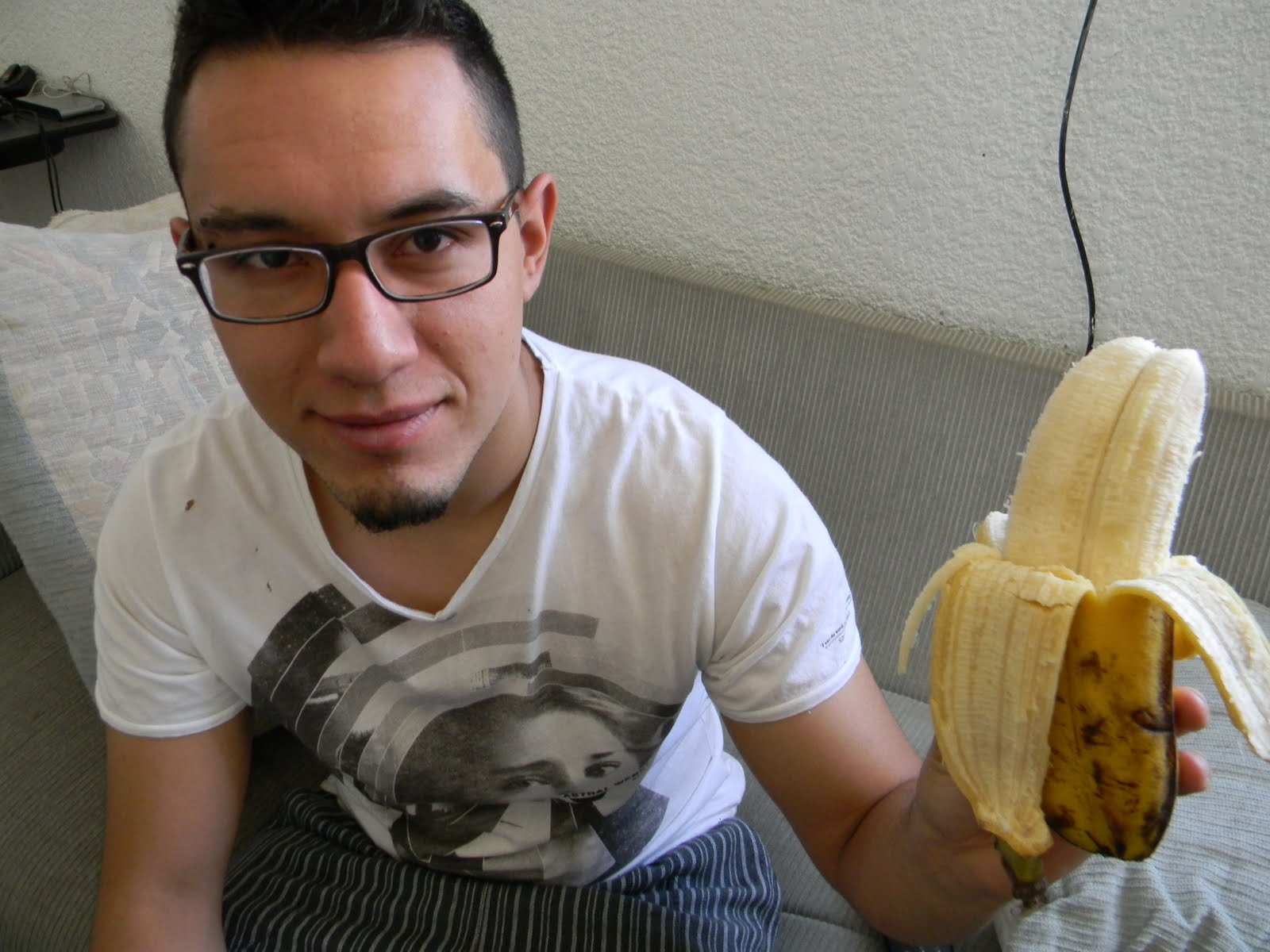
pictures of the few friends I'm able to see these days. In the following pictures you'll see me with Pamela and Lupita in my kitchen (in two lovely portraits with microwaves and water heaters...in which you should also note that my hair has grown long enough to put in two awkward-tiny french-braids! Though I will be the first to admit my lack of braiding skills, resulting in very weird hair situations sometimes), Alfredo (who recently learned to wrap a turban, much to his delight and much to my amusement at his colour choices... and in this photo is featured with a living example of how Mexico City is the public-make-out capital of the Universe) and Marcos, with whom we discovered a freakish double-banana
 at the corner store, which required a proper digital portrait.
This is Hacienda Mixiuhca's first trip into the wide world: yesterday some hippie group put up a little one-day-only bartering market in my hood, so I dropped in after school (would have brought some plants and participated but I saw on the Internets that you had to be "registered" to participate-- lame!). Anyway I dropped in, as I said, saw the middle-aged guy that runs the cooperative coffee shop near Jamaica, and met some kids who live in this crazy 6-story co-op in a squathouse in a nice neighborhood, with about thirty people, called Chanti-Ollin, which is Nahuatl (language of the Aztecs and r
 elated linguistic groups) for something like "Living Movement". They have composting toilets, gardens, bike-powered technology and other bitchin' projects. Worth checking out if you're a domie (or post-domie, though I say that once a domie, you're always a domie, so there's no such thing as an ex-domie, with very few exceptions). Anyway, the point is that I'm finding some good sources of anti-civilization vibes, sweet urban resistance projects, etc...
And then I talked to some kids who live in the Honorable National House for Students, which is a co-op, and houses kids from other states who come to study in the Federal District and have limited financial resources and they have a big
 hydroponics project on their roof. I visited them today, so the photos you see here are from that particular place. It was built in 1911 for that same purpose, but it, like any co-op, has gone through some rough moments in its history. Regardless, it seems in good spirits today. It's located in the infamous neighborhood of Tepito, a region of beautiful and dilapidated colonial architecture, pirated (insert any noun here)s, and the most barrio of the barrios of Mexico City, supposedly. I've never been scared in Tepito, but I've never been scared anywhere in the city, to be totally truthful. Regardless, it's supposed to be very dangerous. I must emphasize, however, that Tepito is NOT a "ghetto." Ghetto implies an isolation, a desperation, that comes with having no economy. Tepito is a buzzing economic microcosm of illegal everythin
 g, but very successful, despite the endemic poverty and rampant violent crime, robberies and other such delights. Anyway, so you squeeze between some street stands selling backpacks and batteries and keychains and other sundries, and knock on the beautiful and seriously degraded old (and gargantuan) wooden door. One of the locks is missing so you can see right in through a sort of accidental peephole. Figures move around within, in the sunlit entryway. The doorframe is a marvelous carved stone affair with images of various disciplines, which you can see in their photostream, which is pretty cool. There's a small plaque at 3m above the
  ground, that declares the building, buried though it is in a mess of informal commerce, the historic institution that it is (actually, it has been declared a Historical Monument by the National Institute of Anthropology and History). A bespectacled boy with a ponytail answers the door. I explain I met some of his housemates at the Barter Market in Mixiuhca and that I wanted to see their hydroponics project. I indicated that I had brought some seedlings to make it worth their time. He told me he was already headed that way and invited us in. He took us up to the tippy-top terrace, a wiggly-floored brick
  affair with a view of countless concrete rooves and the plants that grow in their accumulated muck, water cisterns, and two or three old church bell towers. On the kneewall of the terrace were small paintings of mushrooms and things with wings. A collection of tomato seedlings sat around in pots of dirt on one side, and a plastic-enclosed hydroponic system hid behind them. It's constructed of a series of 4-inch PVC pipe with holes in the top. Elbows on one end of each pipe permit each to be filled with nutrient solution, and a connector on the other with a 1-inch elbow sticking out permits the water to drain when directed downward, into another 4-inch pipe, that drains the excess downward into some kind of catchment to be reused. It's really cool! They germinate their lettuces in petri dishes and let the seedling grow up in little tiny dixie cups in some kind of mix of coconut hus
 k and vermiculite with what I suspect is humus mixed in there. Then they stick them in little round holes in the top of the 4-inch PVC. It's pretty genius. The kid said the hard part was coordinating people. Yeah, tell me about it (can I get a witness, domies?). But he was really nice for showing us around, and even though he didn't seem to want my plants (though another kid took me up on my offer of basil plants, I learned that eggplant and okra are not too popular). Anyway, so that was that. I hope to see more of those folks, because it seems like an interesting place.
I hope to be able to visit Chanti-Ollin next weekend, so you'll probably be seeing shots of that crowd next week.


 The cacao tree gets to be about 5m tall maximum (COMMENT: THE CACAO PHOTOS ARE